Learn how to check and top up engine oil the right way. Simple steps, real numbers, and mistakes that cost thousands in repairs.
- September 14, 2026
AceShowbiz - Your engine has about 100 moving parts that grind against each other thousands of times per minute. The only thing standing between them and a catastrophic meltdown is a thin film of oil — roughly the thickness of a human hair. When that film gets too thin, metal meets metal, and a $40 oil change turns into a $6,000 engine replacement. The good news: checking your oil takes four minutes, and topping it up takes two more. Here's how to do it properly, including the details most people get wrong.
Why Oil Level Matters More Than You Think
Engine oil does four jobs at once: it lubricates, cools, cleans, and seals. When the level drops, all four jobs suffer simultaneously. The pump starts sucking air instead of oil, oil pressure falls, and the parts at the top of the engine — the camshaft and valve train — are the first to run dry because gravity pulls oil down to the pan.
Here's the number that should get your attention: most manufacturers consider one quart of oil consumed per 1,000 miles to be "normal." If your car's engine holds five quarts and you drive 3,000 miles between changes without checking, you could be running on two quarts — a 40% deficit. At that level, oil temperatures spike, and wear accelerates fast.
Low oil is also the leading cause of engine seizure in vehicles under 100,000 miles, according to repair shop data. It's not a slow death, either. A starved engine can go from "running fine" to "knocking loudly" in under a minute at highway speed.
Practical takeaway: Check your oil every other fuel fill-up. It takes less time than waiting for your tank to fill, and it catches slow leaks and consumption before they become emergencies.
When and Where to Check Your Oil
Timing matters more than most people realize. Check your oil when the engine is cold, or at least five to ten minutes after shutting it off. Why? When the engine runs, oil gets pumped up into the cylinder head and the rest of the engine. Shut it off and that oil drains back into the pan — but it takes a few minutes. Check too early and you'll read low, add oil you don't need, and end up overfilled.
Find a level surface. Your driveway is usually fine. A sloped street is not, because the oil pools to one side of the pan and your dipstick reads wrong. If you can only park on a slope, note the direction and adjust your expectation — but honestly, just find flat ground.
You'll need a rag or paper towel, and a quart of the correct oil on hand if you're due for a top-up. Keep a funnel in your trunk if your engine's fill hole is recessed — spilling oil onto a hot exhaust manifold creates smoke and a burning smell that scares people unnecessarily.
Locating the Dipstick
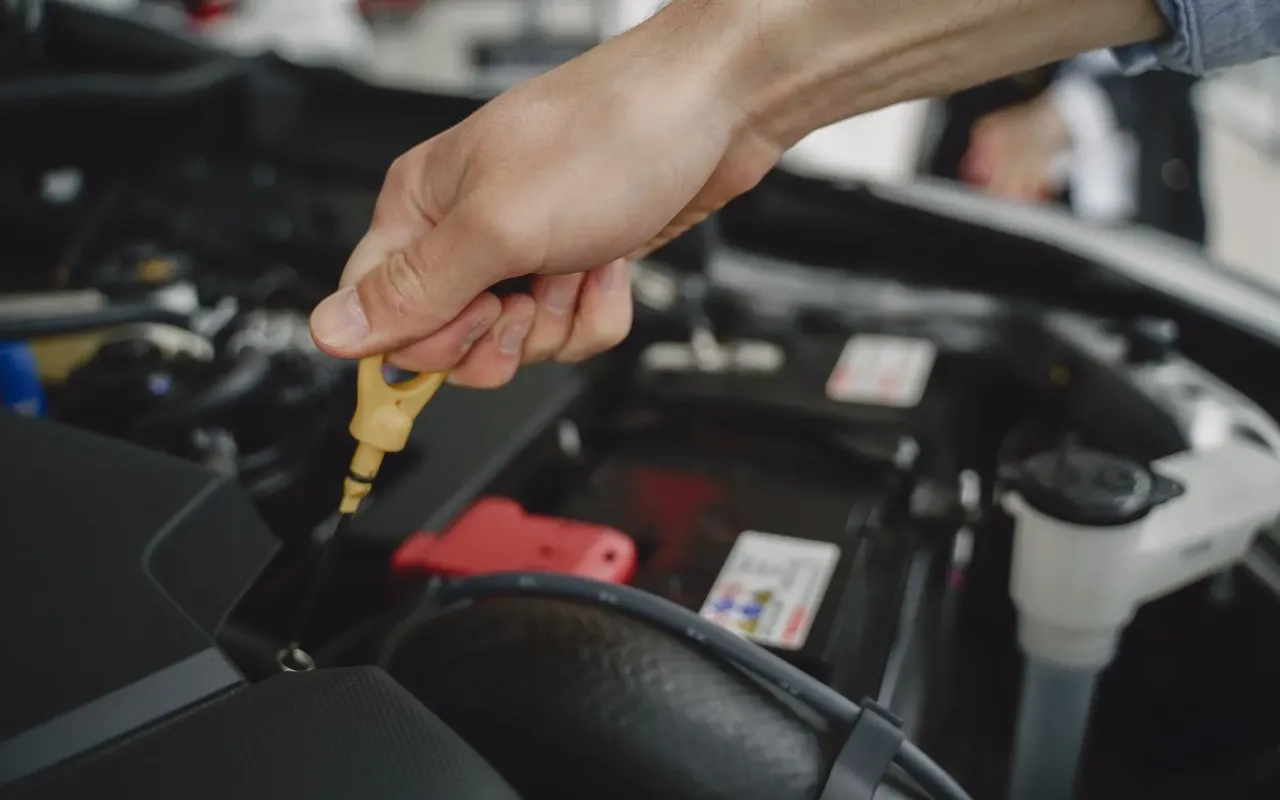
On most cars, the dipstick has a bright yellow or orange loop handle and sits near the front of the engine. Some newer cars — BMW, Mercedes, and a growing number of others — have deleted the dipstick entirely and rely on an electronic sensor you check through the infotainment menu. If you can't find a dipstick, check your owner's manual before assuming it's missing.
Practical takeaway: If your car has an electronic oil level sensor, check it weekly rather than relying on the dashboard warning light. By the time that light comes on, you're usually a quart or more low.
Reading the Dipstick Correctly
Pull the dipstick out, wipe it clean with your rag, then push it all the way back in until it seats. Wait a second, then pull it out again and look at the tip. The first pull is meaningless — it's covered in oil splashed around inside the tube. The second pull gives you the real reading.
You're looking for two marks: a lower hole or notch and an upper one. The distance between them represents roughly one quart on most engines. If the oil film sits at the top mark, you're full. At the bottom mark, you're a quart low. Below the bottom mark, you're in the danger zone and should not drive far before adding oil.
Look at the oil's condition while you're at it. Fresh oil is amber and slightly translucent. Dark brown is normal after a few thousand miles. But if it looks like black coffee, feels gritty between your fingers, or smells burnt, you're overdue for a change regardless of mileage. Milky or frothy oil is a red flag for coolant mixing into the oil — a head gasket problem that needs a mechanic, not a top-up.
What the Marks Actually Mean
That gap between the low and high marks isn't arbitrary. Engineers sized it to represent the difference between safe operating range and inadequate lubrication. Running at the low mark occasionally is fine. Running below it repeatedly is how bearings get scored.
Practical takeaway: Photograph your dipstick reading with your phone when it looks unusual. It gives you a reference point and helps a mechanic diagnose consumption trends.
How to Top Up Without Overfilling
Overfilling is a real mistake, and it causes problems. Too much oil means the crankshaft whips through it, aerating the oil into foam. Foam doesn't lubricate — it's mostly air. Excess oil also gets pushed past seals and into the combustion chamber, causing blue smoke from the exhaust and fouled spark plugs.
Here's the safe method. If you're at the low mark, add half a quart first, not a full one. Wait two minutes for it to drain down, then recheck. Add in small increments until you reach the top mark. Never fill above the top mark, even if you have oil left in the bottle.
Use the correct oil. Your owner's manual specifies a viscosity grade like 0W-20, 5W-30, or 5W-40, and often an API or ILSAC certification. Mixing viscosities won't destroy your engine in an emergency, but it can affect fuel economy and cold-start protection. If you're stuck at a gas station with only one option, add it — running low is worse than running slightly off-spec.
Checking for Leaks and Consumption
If you're topping up more than once between oil changes, something is wrong. Look under your parking spot for dark spots. Check around the valve cover, oil pan drain plug, and oil filter for seepage. Consumption without visible leaks often points to worn valve stem seals or piston rings — a compression test at a shop will tell you which.
Practical takeaway: Keep a log in your phone's notes app: date, mileage, and how much oil you added. Three data points reveal a pattern a single check never will.
Common Mistakes That Cost Real Money
The most expensive mistake is ignoring the warning light. Oil pressure lights mean the engine is already starving. Pull over and shut it off immediately — not in five miles, not at the next exit. Towing costs $100. A new engine costs thousands.
Second most common: checking oil on a cold engine in winter and panicking. Cold oil is thick and clings to engine internals, so it drains back slowly. Give it ten minutes, not two, when temperatures drop below freezing.
Third: using the wrong dipstick reading. Some engines have both an engine oil dipstick and a transmission fluid dipstick, and they're sometimes the same color. Check your manual so you're not adding engine oil to a sealed transmission.
And finally, treating oil changes as optional. Even with perfect level maintenance, oil degrades. Conventional oil breaks down around 3,000 to 5,000 miles; full synthetic holds up to 7,500 to 10,000 in most modern engines. Follow your manual's interval, not the quick-lube sticker.
None of this is complicated. Four minutes with a rag and a dipstick, every couple of weeks, is the cheapest insurance your engine will ever get. Do it once and it becomes muscle memory — and your car will quietly reward you with hundreds of thousands of miles.