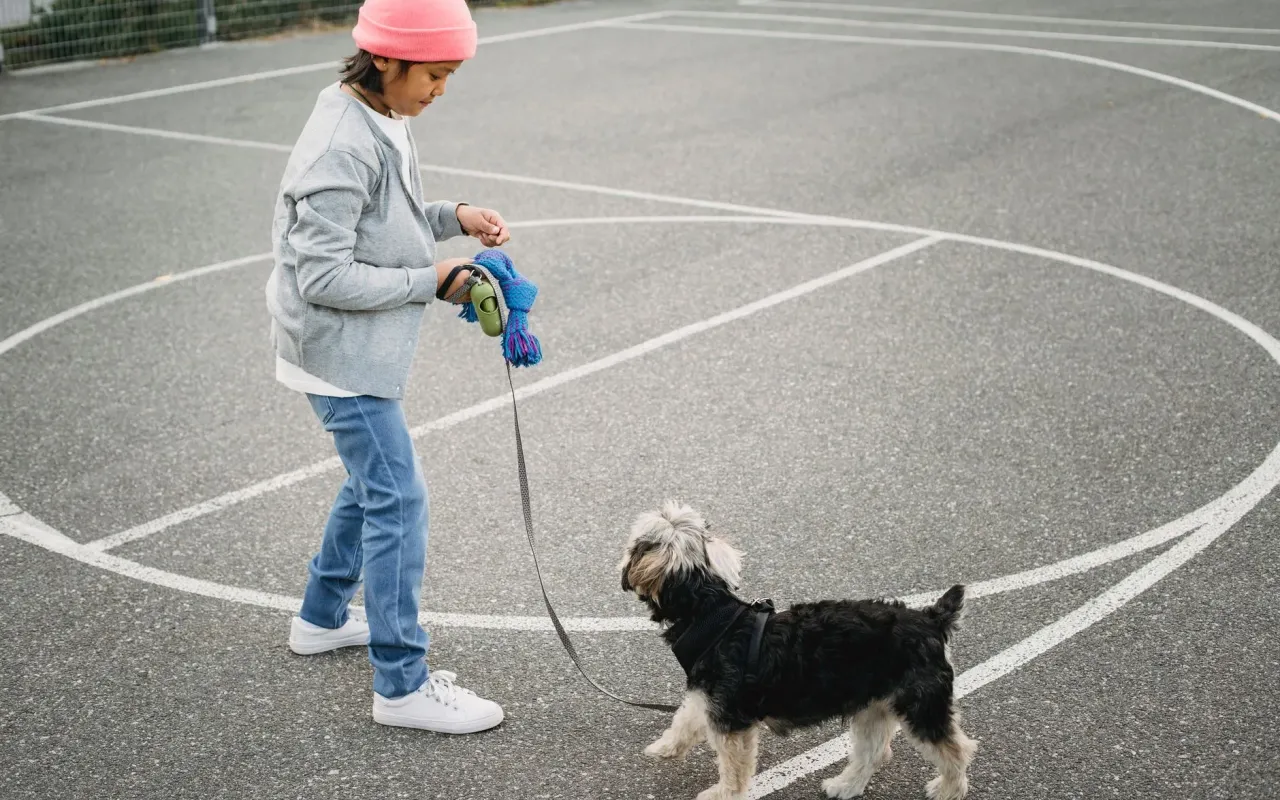
Stop the arm strain and the frustration. Learn practical, force-free methods to teach your dog a relaxed heel, even if they're a chronic puller.
- August 6, 2026
AceShowbiz - You know the drill. You grab the leash, your dog starts spinning in circles, and the moment that clip hits the collar, it's game on. Your arm extends to full length, your shoulder protests, and you spend the next twenty minutes playing a one-sided game of tug-of-war where the only winner is your dog's neck. It's exhausting, it's frustrating, and honestly, it makes you want to skip walks altogether. But here's the thing: pulling isn't a sign of a "bad" dog. It's a symptom of a dog who hasn't been taught that walking calmly next to you is the most rewarding place to be. And the good news? You can fix it with patience, consistency, and a little bit of strategy.
Forget the old-school advice about choke chains or yanking the leash. Modern, science-backed training focuses on rewarding the behavior you want, not punishing the behavior you don't. Loose leash walking isn't about forcing your dog into a perfect heel position like a military drill. It's about creating a default behavior where your dog chooses to stay near you because it pays off. This shift in mindset is the single biggest factor between a walk that feels like a chore and one that feels like a shared adventure.
Why Your Dog Pulls (It's Not About Dominance)
Let's clear up a common myth right now: your dog isn't pulling to assert dominance over you. That theory has been debunked by animal behaviorists for years. Dogs pull for one simple, primal reason: it works. When a dog pulls toward a tree, a fire hydrant, or a friendly stranger, and you follow even a few steps, you've just taught them that tension on the leash equals forward movement. They're not trying to be the "alpha." They're just trying to get to the good stuff faster, and their body is telling them that leaning into the harness is the most efficient way to do it.
Think about it from their perspective. Their nose is a supercomputer capable of processing millions of scent molecules. Yours is a potato. They see a squirrel and their prey drive kicks in. Walking calmly beside you doesn't have the same immediate payoff as chasing a rabbit. So, your job is to make the space beside you more interesting than everything else on the block. That means being a source of treats, praise, and unpredictable rewards. If you're just a boring, silent statue holding a leash, why would they want to be near you?
The pulling also gets reinforced by your own stress. When you're tense and anticipating a pull, you tighten the leash. Your dog feels that tension, which can actually increase their arousal level, creating a feedback loop of anxiety and pulling. The fix? Start with a relaxed mindset and a leash that's a bit slack. You're not going to win a physical battle against a dog who weighs more than you, so don't try. Instead, you're going to win a mental one, and that starts with being more fun than the environment.
Actionable Tip: Before you even step out the door, do a "reset" in your living room. Walk a few steps with your dog on a loose leash. The moment they get to the end of it, stop moving. Don't say a word. Just become a tree. Most dogs will look back at you in confusion within a few seconds. The second they do, mark it with a "yes!" and give them a treat. You've just started rewiring their brain.
The Setup: Gear That Gives You an Edge
Before you can teach your dog anything, you need to set them up for success. This means looking at the equipment you're using. If you're currently using a standard flat collar and your dog is a puller, you're working against physics. A flat collar puts pressure on the most sensitive part of their neck, which can trigger a reflex to push against the pressure, making them pull harder. It also puts you at risk of injuring their trachea or spine if they lunge suddenly.
Consider switching to a front-clip harness. This is a game-changer for many dogs. When the leash clips to the front of their chest, pulling physically turns them back towards you. It doesn't hurt them; it just makes pulling an inefficient strategy. They can't get the leverage they need to power forward. It's a simple mechanical advantage that takes the strain off your arm and their neck, giving you a chance to actually communicate with them instead of just holding on for dear life.
Another option is a head halter, which fits over their snout like a horse's halter. This gives you gentle control over their head direction, which in turn controls their body. However, these require a gradual introduction and aren't suitable for every dog, especially those with flat faces like pugs or bulldogs. If you go this route, spend a week just feeding treats through the halter before you ever clip a leash to it. The goal is to make the gear a positive signal, not a punishment.
Finally, ditch the retractable leash. They are the enemy of loose leash training. They constantly maintain light tension, which teaches your dog that pulling is the default state. They also make it impossible to give clear feedback because the length is always changing. Stick to a standard 4-6 foot leash. It gives you enough room for your dog to sniff and explore, but it's short enough to manage communication effectively.
Actionable Tip: Go to your local pet store and try on a few front-clip harnesses. Look for one that has a good range of motion in the shoulder area so it doesn't restrict your dog's gait. A good harness should fit snugly but allow you to fit two fingers flat between the strap and their skin.
The "Be a Tree" Method: Your First Line of Defense
This is the foundational skill that every other technique builds on. The name is literal: when your dog puts tension on the leash, you stop moving and become immobile like a tree. You don't yank, you don't scold, and you don't even look at them. You just stand there, holding the leash loosely, waiting for the pressure to release. The goal is to teach your dog that pulling doesn't get them where they want to go—it gets them nowhere at all.
Here's the tricky part: you have to be patient. The first time you do this, your dog might stand at the end of the leash for a full minute, looking at you like you've lost your mind. They might even pull harder for a few seconds, testing if you'll give in. This is called an "extinction burst," and it's a sign that the training is working. They're trying their old strategy one last time to see if it still works. If you hold firm, they'll eventually give up and look back at you or take a step towards you.
The moment you feel any slack in the leash, you can start moving again. But here's the secret: you don't just resume walking in the direction you were going. You take a few steps, then stop again. You're creating a rhythm of stop-and-go that makes forward movement the reward for a slack leash. You're teaching them that the walk is a series of choices, and the right choice is to stay with you. This method is boring and slow at first, but it's incredibly effective. You might only walk 100 meters in twenty minutes on the first day. That's okay. You're not walking for exercise; you're walking for training.
As you get better at this, you'll notice your dog starts to check in with you more often. They'll look up at you to see where you're going, and that's the moment you can start rewarding them with a "yes!" and a treat. You're building a communication loop where they're actively choosing to pay attention to you. This is the foundation of a solid walking relationship.
Actionable Tip: Practice "Be a Tree" in a low-distraction environment first, like your driveway or a quiet park. Don't try it on a busy street corner on your first day. You'll just get frustrated. Master it in the boring places, then gradually add more interesting environments.
Making Yourself More Interesting Than the Squirrel
Let's be honest: you will never be more interesting than a squirrel to your dog. That's a fact. But you can be more interesting than the pavement, the lamp post, and the boring stretch of sidewalk. The key is to become a dispenser of high-value rewards. This means treats. And not the sad, dry biscuit you keep in your pocket. We're talking about tiny pieces of boiled chicken, cheese, or hot dogs. These are the "emergency" treats that signal to your dog that you are the most exciting thing on the block.
The technique here is called "random reinforcement." If you give your dog a treat every single time they look at you, they'll get bored. But if you give them a treat for looking at you sometimes, and a jackpot (three treats in a row) other times, they'll be glued to you, waiting for the next surprise. It's the same principle as a slot machine. You don't win every time, but the possibility of winning is enough to keep you pulling the lever. Your dog will be playing a game of "what's in the pocket?" instead of "what's that smell?"
You also need to change your walking pattern. Dogs are creatures of habit, and they get bored with a straight line. Instead of walking in a monotonous straight line, change direction frequently. Walk in zigzags, turn around, do a circle. Every time you change direction, call your dog's name and reward them when they follow. This turns the walk into a game of "follow the leader" rather than a slog down the sidewalk. It keeps their brain engaged, which is actually more tiring than physical exercise. A mentally tired dog is a well-behaved dog.
Finally, don't forget the power of the "sniffari." Allow your dog to stop and sniff things, but on your terms. Instead of letting them drag you to the bush, walk to the bush together and give them a "go sniff" command. Give them a few seconds to explore, then use a "let's go" cue to move on. By controlling the timing, you're teaching them that you're the gatekeeper to all the fun stuff, and they need to be polite to get access.
Actionable Tip: Before your walk, cut up a handful of treats into pea-sized pieces. Put them in a treat pouch or a small baggie that you can easily access. The more accessible the treats, the more likely you are to use them consistently.
Handling the Big Distractions: The "Look at That" Game
You've mastered the basics on a quiet street, but then comes the moment of truth: the neighbor's cat, a skateboarder, or another dog. Your dog's brain goes from "calm companion" to "hunting mode" in a split second. This is where a technique called "Look at That" (LAT) comes in. The premise is simple: you teach your dog that the sight of a trigger predicts a treat. You're changing their emotional response from "I must chase it" to "I see it, and I get a reward."
Here's how to do it. When you see a distraction in the distance—far enough away that your dog isn't already pulling—stop walking. Wait for your dog to notice it. The moment their eyes land on the distraction, say "yes!" and give them a treat. You're not asking them to look at you; you're rewarding them for looking at the thing that used to cause a reaction. This is counter-intuitive, but it works. You're teaching them that the presence of the trigger is a cue for you to give them a treat.
As you do this repeatedly, you can start moving closer to the trigger, but only as long as your dog remains under their "threshold." Threshold is the point where they're aware of the distraction but not so worked up that they can't think. If they start pulling or whining, you've gotten too close. Back up a few steps and try again. The goal is to keep them in a state of calm awareness, not excitement.
This technique takes time, and you won't be able to walk past a pack of dogs on the first try. But over weeks and months, you'll find that your dog starts looking at distractions and then automatically looking back at you, expecting a treat. That's the moment you've won. They've chosen you over the trigger, and that's the ultimate goal of loose leash walking.
Actionable Tip: Start practicing LAT in your living room with a toy. Place the toy on the floor, and the moment your dog looks at it, mark and reward. This builds the muscle memory before you ever try it outside.
When to Walk and When to Stop: The 5-Minute Rule
One of the biggest mistakes owners make is expecting a perfect walk every single time. Some days, your dog is going to be more aroused, more distracted, or just plain having a bad day. On those days, you need to know when to call it quits. The "5-Minute Rule" is a simple guideline: if you've been walking for five minutes and your dog is still pulling consistently, you're not training, you're fighting. The session is no longer productive, and it's actually making the behavior worse by reinforcing it.
When this happens, don't just yank them home. Instead, do a "reset." Stop walking, ask for a couple of easy behaviors they know well, like "sit" or "touch," and reward those. This brings their brain back online. Then, make the walk easier. Go back to the "Be a Tree" method. Or, if you're close to home, just turn around and head back. There's no shame in ending a walk early. You're not giving up; you're making a strategic decision to end the session on a positive note, even if that note is just "we stopped pulling for ten seconds."
It's also important to recognize that walking on a leash is a skill that needs to be practiced in short, frequent bursts. A 10-minute focused training walk is infinitely more valuable than a 40-minute walk where your dog pulls the entire time. Think of it like going to the gym. You wouldn't try to deadlift your max weight on your first day. You'd start with lighter weights and work on your form. The same principle applies to your dog. Build up their stamina for good behavior gradually.
Finally, remember to celebrate the small wins. Did you walk ten steps without pulling? That's a win. Did you pass a mailbox without your dog trying to mark it? That's a win. Acknowledge these moments, both to yourself and to your dog. Your positive energy is contagious. If you're enjoying the walk, your dog is more likely to enjoy it too, and that shared enjoyment is the real secret to a lasting, relaxed partnership.
Actionable Tip: Keep a training journal. After each walk, write down one thing that went well and one thing you want to work on tomorrow. This helps you track progress and keeps you motivated when it feels like you're not making any.