Experience Paweł Pawlikowski’s stunning black-and-white film, Fatherland. Sandra Hüller stars in a gripping 1949 journey as Thomas Mann returns to a divi...
- May 16, 2026
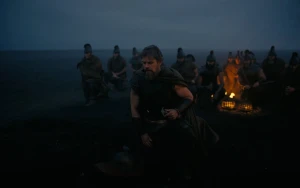
AceShowbiz - Fatherland, the latest film by Paweł Pawlikowski, continues the director’s fascination with black-and-white cinematography, a style he has perfected in previous works like Cold War and Ida. The film’s monochrome visuals, captured by ?ukasz ?al—renowned for his work on Hamnet and The Zone of Interest—turn light and shadow into expressive elements that highlight the emotional depth of the characters, especially the remarkable performance by Sandra Hüller.
Set in 1949, Fatherland unfolds against the backdrop of a divided postwar Germany. The story follows the renowned novelist Thomas Mann (played by Hanns Zischler) as he embarks on a journey back to his homeland for the first time since fleeing in 1933. Accompanying him is his daughter Erika (portrayed by Sandra Hüller), who serves as his assistant, driver, editor, and barber during the trip. This journey is marked by Mann’s acceptance of two Goethe Prizes: one from the West German government in Frankfurt, Goethe’s birthplace, and another from the East German authorities in Weimar, where Goethe died.
The film’s narrative zeroes in on this brief but significant excursion, compressing the timeline to include the recent suicide of Erika’s brother Klaus, which occurred two months earlier in the south of France. Pawlikowski deliberately chooses this narrow temporal focus to contrast with the vast historical and political upheaval surrounding the characters. At just 82 minutes, Fatherland delivers a concentrated, intense experience that mirrors the fractured state of postwar Europe.
The divided Germany depicted in the film is a landscape of shattered ideals and uneasy reconciliations. In the East, under Soviet influence, there is a harsh effort to erase the recent past and build a communist future, while the West moves forward on a tenuous foundation of denial regarding its Nazi history, guided in part by covert American interests. This political tension is reflected in the personal encounters that Thomas and Erika face throughout their journey.
At the Frankfurt gala, Thomas Mann is approached by two young men claiming to be grandsons of the composer Richard Wagner, seeking his help to rehabilitate Wagner’s reputation and restore the Bayreuth opera house. Mann’s sharp rebuke—"Your mother should be put on trial and the opera should be razed"—underscores the lingering cultural wounds tied to the Nazi regime’s appropriation of Wagner’s legacy.
Meanwhile, Erika confronts her ex-husband, the actor Gustaf Gründgens (played by Joachim Meyerhoff), who insists that Hermann Göring personally sought him out, defending his own complicity with the regime as a matter of survival. Their interaction is charged with tension, culminating in a slap from Erika that highlights her refusal to accept complacency or denial.
In Weimar, the atmosphere is surreal and chilling. Children sing a newly composed anthem as a Red Army colonel discusses Mephistophelean dialectics, symbolizing the ideological battle being waged. A man who visits Thomas to reveal the grim transformation of the Buchenwald concentration camp into a political prison is abruptly taken away, signaling the dangerous environment in which truth is suppressed.
Hanns Zischler portrays Thomas Mann as a figure of intellectual detachment, unwilling to be co-opted by either East or West German governments. His speeches on Goethe and the dream of a Good Germany remain lofty and abstract, emphasizing his distance from the political realities around him.
In contrast, Erika is deeply affected by the turmoil of the era and the personal loss of her brother Klaus, played by August Diehl. The film opens with a poignant conversation between the siblings, where Klaus confesses, "I don't believe in anything anymore," capturing the despair and disillusionment that permeate the story. Erika’s emotional rawness surfaces in moments such as when she confronts drunken men on the street, calling them "fascist scum," a gesture that reveals her anger and refusal to forget the past.
This substitution of Erika for Mann’s wife Katia, who accompanied him in reality, is a notable creative choice by Pawlikowski. It allows the film to explore a more conflicted and impassioned perspective through Erika’s character, who carries the weight of memory and loss more visibly than her father.
Sandra Hüller is having a remarkable year beyond Fatherland. She won the Silver Bear for her role in Rose, portraying a woman disguising herself as a male soldier to claim an inheritance. Additionally, she appears as the pragmatic head of an international task force in the blockbuster Project Hail Mary. Yet it is in Fatherland that she delivers a quietly powerful performance, embodying the emotional core of a film steeped in the shadows of history.
Fatherland premiered in competition at the 2026 Cannes Film Festival, where its brief yet intense storytelling and evocative black-and-white cinematography have drawn critical attention. The film’s ability to condense vast historical trauma into a concentrated narrative highlights Pawlikowski’s skill in marrying visual style with profound thematic exploration.
Through the journey of Thomas and Erika Mann, Fatherland examines the fractured nature of postwar German identity and the uneasy attempts at reconciliation in a society still grappling with its recent horrors. The film’s focus on personal grief and political ambiguity invites viewers to reflect on the challenges of memory and the complexities of history.
In sum, Fatherland stands as a testament to Paweł Pawlikowski’s mastery of monochrome storytelling and to Sandra Hüller’s compelling portrayal of a woman navigating the difficult aftermath of war and loss. Their collaboration creates a cinematic experience that is both intimate and expansive, capturing the fragile state of a world striving to move forward while still haunted by the past.