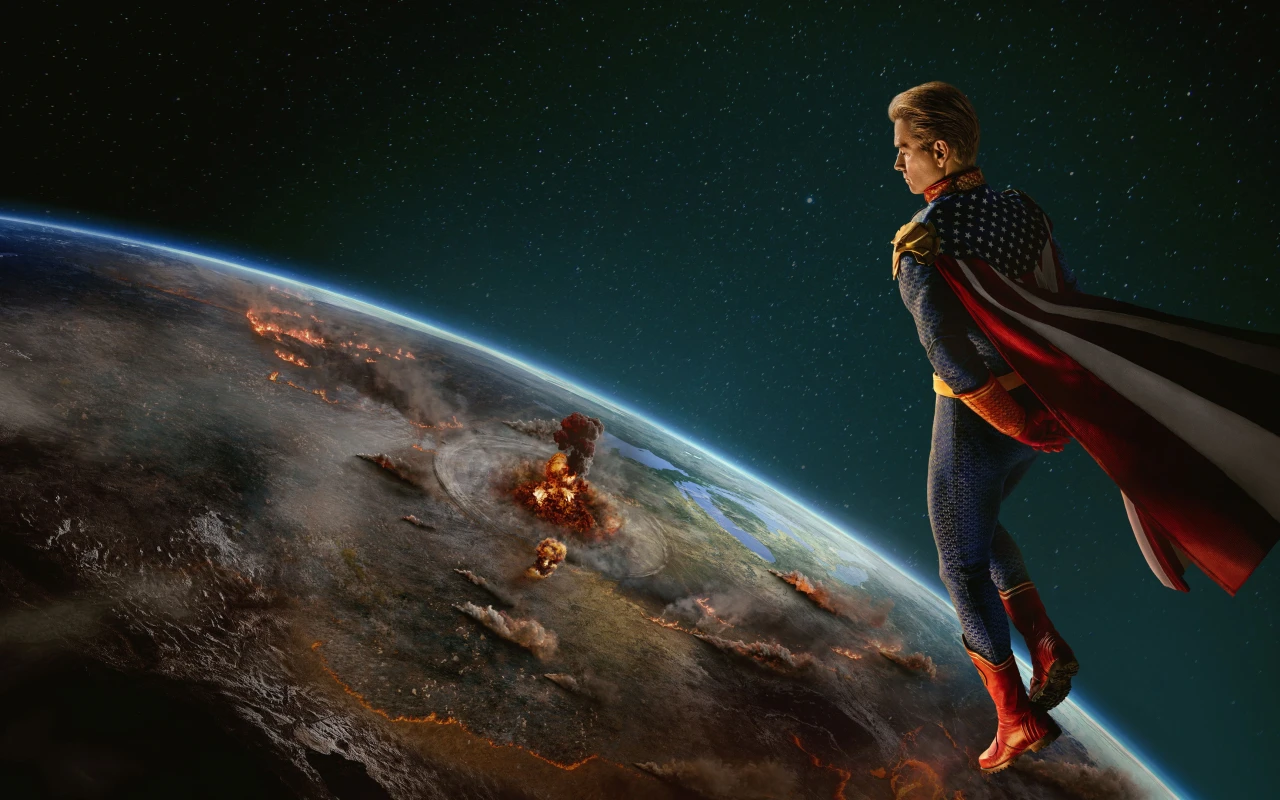
The Boys season 5 recycles its signature super-speed gore, but the joke feels stale. A celebrity cameo massacre undermines the show's satire.
- April 30, 2026
AceShowbiz - The Boys has revived one of its oldest visual gags in its fifth season: the superfast superhero running through people and bursting them apart. The series began with this violence, as A-Train accidentally killed Hughie's girlfriend in the street, setting Hughie on his quest for revenge against the supes. Yet in the show's final season, this repetition feels less like a meaningful callback and more like a fallback. When The Boys depicts Soldier Boy manipulating celebrity cameos Craig Robinson, Kumail Nanjiani, and Christopher Mintz-Plasse into the path of Mister Marathon, the result is a gorefest that undermines the show's satirical effectiveness.
This week's episode, "One-Shots," features a Supernatural reunion with Jensen Ackles, Jared Padalecki, and Misha Collins. The episode winks so hard at the audience that it loses sight of the show's entertainment-industry critique. By the time series executive producer Seth Rogen is cut in half by Mister Marathon, and Soldier Boy assures him his legacy will live on in the straight-to-streaming movie An American Pickle, the show has lost its satirical focus entirely. Every arc of blood spray feels as enervating for the show's efficacy as a satire as it is for these characters.
With three episodes left, The Boys has made little progress toward answering its series-long question: Can Homelander be killed, and can Butcher, Hughie, Annie, and their group of resistance fighters pull it off? The final season has gone back and forth, introducing a virus that could kill all the supes and then destroying the Boys' cache of it, then introducing a Vought formula that makes supes immortal and giving it to Homelander. He has grown increasingly powerful and insane as the season has progressed, while Hughie and Butcher continue arguing about whether it is moral to want to kill him. This dynamic, stretched out to pad a delayed-gratification season, feels more padded than ever in "One-Shots."
Narratively, "One-Shots" is a Rashomon-style detour devoted to characters whose perspectives are not normally centered, such as the Method actor now playing Black Noir and Butcher's dog Terror. In reality, it serves as an excuse for showrunner Eric Kripke to nod to his prior series Supernatural by staging a reunion with Ackles, Padalecki, and Misha Collins, while making flimsy jokes about how certain celebrities process fascism as a way to add lines to their filmographies. When national reality includes Pete Hegseth giving Kid Rock joyrides in military helicopters, jokes about Will Forte discussing Bill Hader's execution being great for his career, or Mintz-Plasse wanting Michael Cera to get "vanished" because "I really need this part" simply do not pack much punch. The joke that celebrities are self-involved feels stale, and actors with liberal politics playing exaggerated versions of themselves burying their heads in the sand as the world ends has already been done by several of these same actors.
Kripke has insisted that The Boys, which premiered more than two years into Donald Trump's first presidency, has always been about Trump's unlikely rise and reign. However, the parallel between Trump and Homelander was not initially the series' prevailing satirical mode. At first, The Boys was a send-up of the Marvel- and DC-dominated entertainment industry and how pop culture was defined by childish superhero worship that filtered into myriad veins of commerce. Movies and television shows, tie-ins with clothing brands, grocery-store chains, and energy drinks — the Seven would shill anything affiliated with Vought, no matter how ludicrous. In a time when blockbuster movies regularly roll out with attached marketing stunts and celebrities feel focus-group tested and media trained into monotony, The Boys displayed a keen understanding of corporate greed and how CEOs can justify anything, even aligning with Nazis, if it ensures additional profits.
As The Boys moved more vigorously into aligning Homelander with Trump, its satirical scope narrowed. The series became so focused on either ascribing Trump's statements to Homelander or charting where Trump's rhetoric could lead that it lost track of the industry it once mocked so well. In this fifth season, the gags about Hollywood feel more superficial than ever — celebrities love doing cocaine and having sex; influencers are soulless opportunists; canceled A-listers will always find a way to reinvent themselves. Kripke has said that the show was suddenly telling a story about the intersection of celebrity and authoritarianism and how social media and entertainment are used to sell fascism. But by pivoting its final season toward church service as authoritarian entertainment, The Boys feels like it is going through the motions of someone else's critique. Presenting how the religious right has abandoned its alleged values with so much singing, dancing, and costuming in shades of royal purple and creamy white feels like a pastiche of The Righteous Gemstones rather than a distinct take.
What The Boys could be saying more broadly about how superhero entertainment has been used to prop up the military-industrial complex — what the series used to say in its earlier seasons — is absent. Homelander's freedom camps show Dawn of the Seven every night, and there is a mention of a blockbuster named G-Men: Days Past From the Future, and apparently the Lamplighter: Light of Justice finale got a D- on The A.V. Club. These throwaway lines illustrate nothing about Homelander's project of using the entertainment industry to sell his traditionalist vision of America. They cater to an audience who remembers X-Men: Days of Future Past was a movie and probably agrees that The A.V. Club's recaps are graded too harshly.
The underlying question is how effectively a show that mocks the entertainment industry can do so when it is itself part of that industry. When The Boys began generating spinoff shows and integrating those characters into its main narrative with the expectation that every viewer would be aware of that interconnected plotting, announced brand partnerships of its own, and was dubbed by Prime Video as the center of the streamer's Vought Cinematic Universe, it felt like the series lost its right to claim outsider status. "One-Shots" cements this loss. The gang of Seth & Co. are presented as pathetic but individually so: Rogen's pottery is the butt of a joke, Forte is derisively called MacGruber. Lena Dunham and Mischa Barton also catch strays, the former for possibly writing for The Atlantic and the latter for wanting to give Homelander a blowjob. All of this chatter feels vaporous because The Boys has spent so little time this season depicting anything similar to the events the comedians discuss in the scene preceding their demise.
In its final stretch, The Boys appears to have run out of fresh satirical fuel. The show that once brilliantly skewered corporate greed and superhero worship now relies on celebrity cameos and Supernatural nostalgia to generate interest. The entertainment-industry critique that defined its early seasons has been replaced by a narrower political allegory that feels less incisive with each episode. As the series approaches its conclusion, it remains unclear whether it can recapture the sharpness that made it a cultural phenomenon, or whether it will end as a show that lost sight of its own satirical mission while winking too hard at its audience.
This article is based on reporting originally published by Vulture.