Explore how conversational AI is becoming an invisible assistant behind entertainment, from story development and research to promotion, audience analysis, and creative experimentation.
- September 22, 2026
AceShowbiz - Hollywood has always depended on people who rarely appear on screen. Editors, researchers, assistants, publicists, script coordinators, production managers, and countless other specialists help transform an idea into something audiences can watch, discuss, and remember.
Now another kind of backstage participant is entering that ecosystem: conversational artificial intelligence.
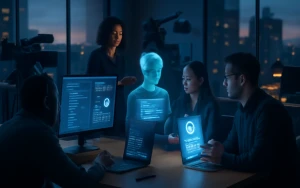
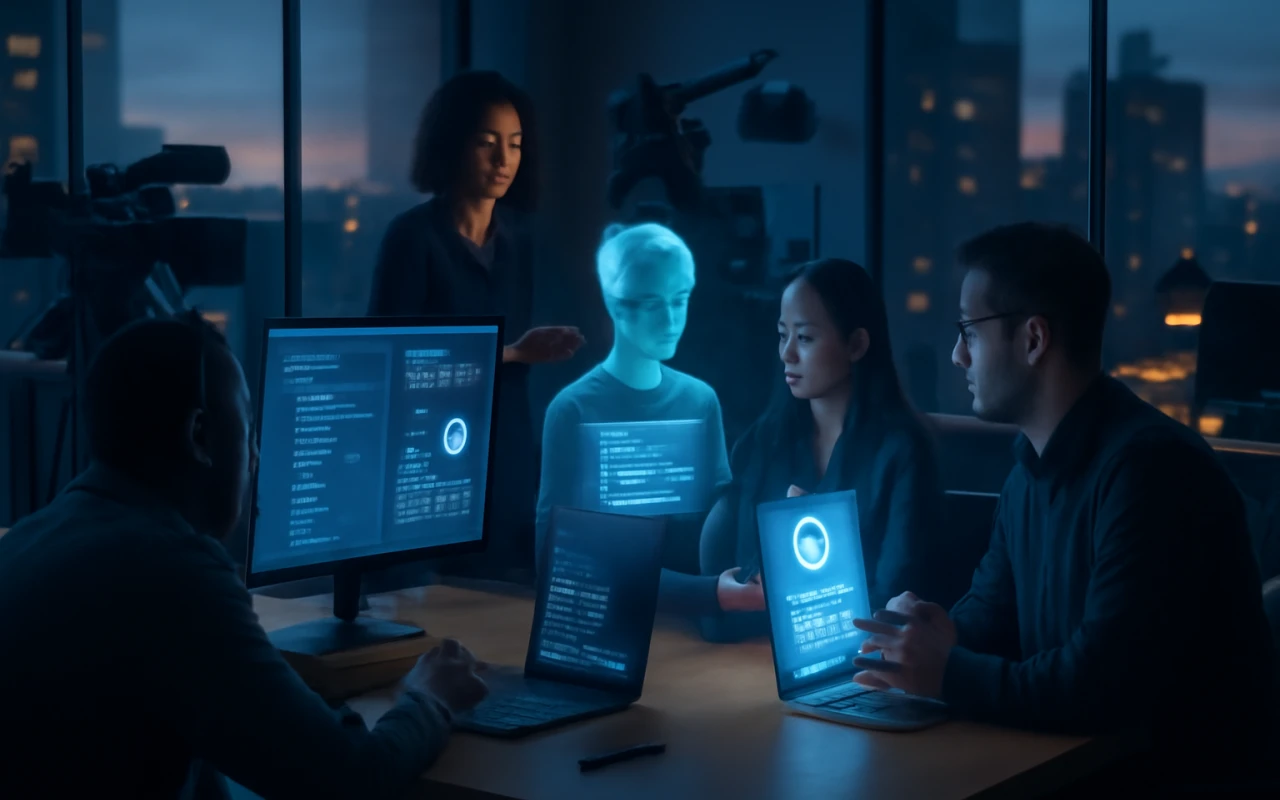
Unlike traditional entertainment software designed for one specific task, a chat-based AI platform can move between questions, ideas, research, drafts, summaries, and creative experiments. That flexibility makes AI less like another piece of production software and more like an invisible member of the crew.
The interesting question is not whether AI will “replace Hollywood.” It is how it may change the enormous amount of work that happens between the first idea and the final audience reaction.
The Entertainment Industry Has a Hidden Problem: Creative Friction
Entertainment looks glamorous from the outside, but much of the daily workflow involves repetitive mental tasks.
A producer may need to investigate a historical detail before approving a scene. A writer might want to compare several interpretations of a character. A marketing team may need multiple versions of a synopsis for different audiences. A journalist researching a celebrity story may have to organize dozens of fragments of information before writing a coherent piece.
None of these activities necessarily requires another human specialist sitting beside the creator every minute.
This is where conversational AI becomes interesting.
Instead of opening a different application for every small question, a creator can begin with a conversation and use it to explore the problem from several directions.
From Search Box to Creative Conversation
Traditional search is excellent when someone already knows what information they need.
Creative work is often different.
A screenwriter may know that a scene feels wrong without knowing why. A producer may have a vague idea for a promotional campaign but no defined concept. A journalist may have several disconnected facts but need help identifying a logical structure.
Conversation allows the user to start with an incomplete thought.
That makes AI particularly useful during the messy middle stage of creative work—the point where an idea is neither completely undefined nor ready for production.
What Could an “Invisible AI Crew Member” Actually Do?
The most useful role for AI may not be generating finished entertainment at all. It may be helping people move through the steps surrounding the creative process.
1. Story Development
Writers can use conversational AI as a brainstorming partner.
It can help examine character motivations, propose alternative scenarios, identify unanswered questions, or challenge an obvious plot direction. The writer remains responsible for deciding which ideas deserve to survive.
That distinction matters. A machine can produce possibilities quickly, but storytelling still depends on judgment, emotion, cultural context, and personal experience.
2. Entertainment Research
Behind almost every convincing story is research.
Historical dramas require factual investigation. Biographical projects involve timelines and relationships. Even fictional stories often need realistic details about locations, professions, technology, or social environments.
A chat-based AI platform such as Use AI can function as an initial research companion, helping users organize questions and explore unfamiliar subjects before they move toward more specialized sources.
For creators, the value is often not the final answer but the ability to ask follow-up questions without repeatedly rebuilding the context.
3. Marketing Experiments
Entertainment marketing is another area where ideas must be tested quickly.
Imagine a team preparing a movie announcement. Instead of developing one promotional message immediately, they could explore several conceptual directions:
- A mysterious teaser focused on the story
- A character-driven campaign
- A nostalgic campaign aimed at longtime fans
- A short social-media concept built around a memorable quote
- A behind-the-scenes angle emphasizing the production itself
The AI does not determine which campaign should be published. It simply makes experimentation cheaper and faster.
AI Could Become Part of the “Pre-Production” of Almost Everything
One of the most overlooked possibilities is that conversational AI can influence entertainment before audiences ever see the finished product.
Consider a fictional streaming series.
Before filming begins, a team may need to develop:
Concept → Characters → Research → Story structure → Marketing ideas → Audience questions → Promotional material
AI can potentially assist at several points along this chain.
That creates a different model of entertainment technology. Instead of one application being responsible for one task, conversational AI becomes a flexible layer connecting many kinds of intellectual work.
Why Human Taste May Become More Important, Not Less
There is an apparent contradiction here.
If AI makes it easier to generate ideas, drafts, concepts, and variations, shouldn't creativity become less valuable?
Possibly the opposite could happen.
When generating ten ideas becomes easy, choosing the right one becomes more important.
Entertainment has never been based purely on producing information. Audiences respond to tone, originality, timing, personality, emotion, cultural meaning, and surprise. Those qualities are difficult to reduce to a checklist.
This is why experiences such as Use AI reviews are interesting to consider from a workflow perspective. The appeal of a chat-based AI platform is not necessarily that it creates a finished Hollywood product with one command. Its value can be in giving a person a flexible conversational space for thinking, testing, questioning, and refining ideas.
The Future Entertainment Workflow May Look Less Like a Toolbox
For decades, digital production has followed a toolbox model: one application for editing, another for design, another for research, another for communication, and another for analytics.
Conversational AI introduces a different possibility.
The interface becomes the conversation, while the task changes from moment to moment.
For an entertainment professional, that could mean using the same AI environment to:
- Explore a story idea.
- Question an assumption.
- Organize research.
- Generate alternative concepts.
- Rewrite material for a different audience.
- Prepare questions for an interview.
- Brainstorm promotional angles.
The technology is therefore less interesting as an “automatic creator” than as an invisible production assistant.
The New Backstage
The most important AI revolution in entertainment may not happen on screen.
It may happen backstage, in the hundreds of small decisions, questions, revisions, experiments, and research sessions that audiences never see.
The actors will still perform. Directors will still direct. Writers will still make creative choices. Editors will still shape rhythm. Publicists will still understand audiences.
But an invisible conversational assistant may increasingly sit somewhere between all of them—quietly helping people turn unfinished thoughts into workable possibilities.
And in an industry built around imagination, that may be one of the most consequential roles technology can play.