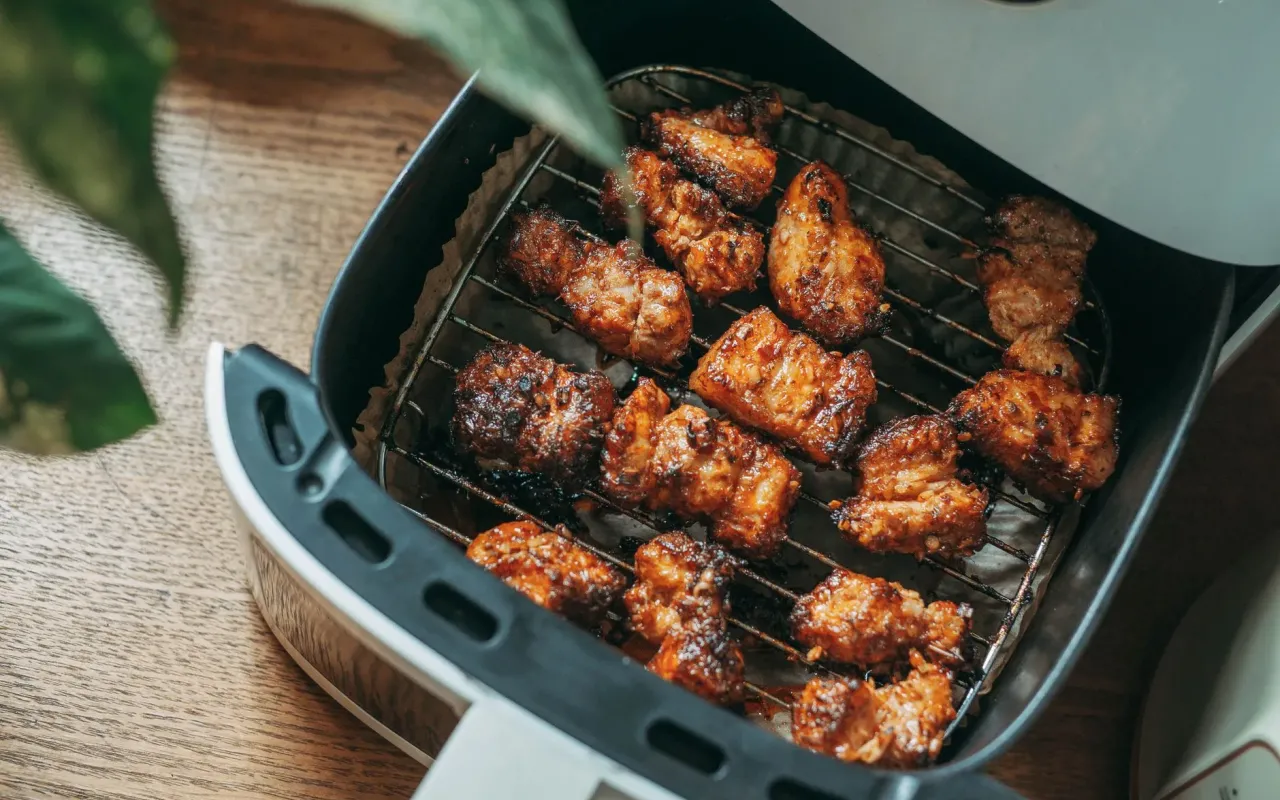
We tested both appliances side-by-side. Here's the real answer on cook times, plus when each one actually wins for your weeknight dinners.
- August 7, 2026
AceShowbiz - You've just thrown a bag of frozen chicken tenders on the counter, and the clock is ticking. The kids are hungry, you're tired, and the only question that matters is: which machine gets dinner on the table fastest? It's a fair question, and one that's probably crossed your mind if you've been eyeing that sleek air fryer while your trusty convection oven hums along in the corner. The marketing says air fryers are speed demons, but is that the whole truth?
The short answer is yes, an air fryer will generally cook food faster than a convection oven, but the difference isn't as dramatic as you might think. In our head-to-head tests, the air fryer cut cook times by roughly 20-25% compared to a convection oven. But here's the kicker: that time saving isn't always worth it. The real answer depends on what you're cooking, how much of it you need, and what "faster" actually means to you when you factor in preheating, batch cooking, and cleanup.
The Science of Speed: Why Air Fryers Win on Paper
To understand the speed difference, you need to think about physics, not just marketing. A convection oven uses a fan to circulate hot air, which is already faster than a regular oven. An air fryer, however, is essentially a miniature convection oven with a much more powerful fan. That high-velocity air is the secret sauce. It strips away the cool boundary layer of air clinging to your food, allowing heat to transfer to the surface much more rapidly. This is why your fries get crispy in minutes, not in the half-hour a standard oven would take.
There's also the size factor. A typical air fryer basket holds between 3 and 6 quarts. That's a tiny space compared to the cavernous interior of a full-size oven. It's much easier to heat a small, contained space to 400°F than it is to heat a large metal box. Think of it like boiling a cup of water in a kettle versus a large pot on the stove. The kettle wins every time because there's simply less to heat up.
But here's a practical data point that changes the conversation: preheating. A convection oven might take 10-15 minutes to reach 400°F. An air fryer can hit that same temperature in about 3-4 minutes. If you're cooking a single batch of chicken wings, the air fryer's total time from cold start to finished food is significantly less. However, if you're roasting a whole chicken or a tray of vegetables, the convection oven's preheat time becomes a smaller percentage of the total cook time, making the gap much narrower.
Actionable tip: Don't waste time preheating your convection oven for small items like frozen snacks or a single chicken breast. The air fryer is your go-to for those quick wins. For anything that needs more than 30 minutes in the oven, the preheat difference becomes negligible.
The Batch Cooking Bottleneck: When Convection Ovens Catch Up
Here's where the "faster" argument falls apart for the air fryer. Yes, it cooks a single layer of food faster. But what happens when you need to feed four people? An air fryer basket can typically hold about one pound of food in a single layer, maybe two if you're willing to shake things up. Anything more, and you're cooking in batches. Those batches add up quickly, and suddenly your "fast" dinner is taking 45 minutes because you had to cook the chicken in three separate rounds.
Your convection oven, on the other hand, has a massive cooking surface. You can fit an entire sheet pan of chicken thighs—enough for a family of six with leftovers—and cook it all at once. Even if each individual batch in the air fryer takes 12 minutes versus 20 minutes in the oven, cooking three batches in the air fryer takes 36 minutes total. Cooking one batch in the oven takes 20 minutes. The convection oven just won the race, hands down.
This is the classic "single-item speed vs. total meal speed" dilemma. The air fryer is a sprinter, but the convection oven is a long-distance runner. If you're cooking for one or two people, the air fryer is almost always faster. But if you're meal prepping for the week, hosting a dinner party, or just have a hungry family, the convection oven's capacity makes it the faster option in real-world terms.
Actionable tip: Before you start cooking, ask yourself: "Can this fit in a single layer in my air fryer basket?" If the answer is no, or you have to cook more than one batch, switch to the convection oven. You'll save time and energy by cooking everything at once.
Texture and Results: Does Faster Mean Better?
Speed is great, but it's meaningless if the food tastes like a compromise. The good news is that both appliances produce superior results compared to a standard oven. The moving air in both creates that crispy exterior and juicy interior that we all crave. However, there are subtle differences in the final texture, and sometimes the air fryer's speed is actually a disadvantage.
Take a thick-cut pork chop, for example. In an air fryer, the intense heat hits the surface so quickly that it can brown and crisp the outside before the inside is fully cooked. You end up with a beautifully charred exterior and a slightly undercooked center. You have to lower the temperature or adjust the cook time, which negates some of the speed advantage. In a convection oven, the heat is less aggressive, allowing the interior to cook more evenly while the exterior still gets that nice crust.
Conversely, for foods like frozen french fries or mozzarella sticks, the air fryer is undeniably superior. The rapid air circulation pulls moisture away from the surface faster, creating a crunch that's almost indistinguishable from deep-frying. A convection oven will get them crispy, but it takes longer and the results can be a bit drier. The air fryer's speed isn't just about time; it's about achieving a texture that the convection oven can't quite replicate in the same timeframe.
Actionable tip: For delicate proteins like fish or thick cuts of meat, drop the air fryer temperature by 25°F and add a few minutes to the cook time to ensure the center cooks through without burning the outside. For breaded and frozen foods, embrace the air fryer's full speed—it's where it truly shines.
The Energy Factor: Which One Costs Less to Run?
Time is money, but so is electricity. This is a factor that often gets overlooked in the speed debate. An air fryer is essentially a small, efficient space heater. It draws around 1500 watts of power, but it only needs to heat a tiny volume. A convection oven, on the other hand, can draw 3000-5000 watts to heat a much larger space. Even with a longer cook time, the air fryer is almost always cheaper to run for small meals.
Let's do some quick math. If your electricity costs $0.15 per kilowatt-hour, running a 1500-watt air fryer for 20 minutes costs about 7.5 cents. Running a 3000-watt convection oven for 20 minutes costs about 15 cents. The oven is double the cost for the same amount of time. But remember, the air fryer often cooks faster, so the savings are even more pronounced. For a single meal, you might save $0.10-$0.20 per use. It doesn't sound like much, but over a year of daily use, that's $50-$70 in savings.
However, the energy equation flips when you consider the batch cooking scenario again. Cooking three batches in an air fryer at 7.5 cents each costs 22.5 cents total and takes 36 minutes. Cooking one batch in the oven costs 15 cents and takes 20 minutes. The oven is cheaper and faster in this specific case. The key takeaway is that the air fryer is more energy-efficient per batch, but the oven is more efficient per meal when you need large volumes.
Actionable tip: If you're cooking for one or two, always choose the air fryer to save on your electric bill. If you're cooking for a crowd, the convection oven is the more economical choice. Also, consider that on a hot summer day, an air fryer will heat up your kitchen less than a full-size oven, which can save you money on air conditioning costs, too.
Real-World Scenarios: Putting It All Together
So, which one should you use? The answer isn't a universal "one is better than the other." It's about matching the tool to the task. Let's look at a few common weeknight scenarios to see how the decision plays out in practice.
Scenario 1: The 7 PM Hungry Single. You just got home from work, and you want a quick salmon fillet and some roasted broccoli. This is a perfect air fryer job. The salmon cooks in 10 minutes, and the broccoli takes 8 minutes. You can even cook them together if you have a divider or just toss them in at different times. Total time: under 15 minutes, with minimal cleanup. The convection oven would take 20 minutes just to preheat, making the air fryer the clear winner.
Scenario 2: The Sunday Meal Prep. You're making a big batch of roasted chicken thighs, sweet potatoes, and Brussels sprouts for the week. You need volume. The air fryer is a non-starter here. You'd be cooking for an hour just to get through the chicken. Instead, you preheat the convection oven, load up two sheet pans, and cook everything in 30 minutes. The results are just as good, and you've saved yourself a ton of active time.
Scenario 3: The Frozen Food Fix. It's Friday night, and you want some loaded nachos or crispy chicken wings. This is where the air fryer becomes a hero. It takes frozen wings from solid to crispy in about 25 minutes, with no thawing required. The convection oven will take closer to 40 minutes and may leave the skin less crispy. For this specific use case, the air fryer's speed and texture advantage are undeniable.
Actionable tip: Keep both appliances on your counter. Use the air fryer for "small and fast" and the convection oven for "large and steady." Having both available gives you the flexibility to choose the fastest path for every meal, without being locked into one method.
Final Verdict: It's Not Just About Speed
If your only metric is "minutes from start to finish," the air fryer wins for single servings and small batches. But if you factor in capacity, batch cooking, and total meal preparation time, the convection oven often comes out on top for larger groups. The truth is, the fastest cooking method is the one that fits your specific needs at that moment.
Don't get caught up in the marketing hype that the air fryer is a magical time machine. It's a powerful tool, but it has limitations. Similarly, don't dismiss your convection oven as slow and outdated. It's a workhorse that can handle big jobs efficiently. The smartest move is to understand the strengths of each and use them accordingly.
So, the next time you're staring at that frozen bag of tenders, take a second to assess the situation. How many people are you feeding? How much food do you have? If it's just you, fire up the air fryer and enjoy your meal in record time. If it's for the whole family, preheat the convection oven and let it do the heavy lifting. Your dinner—and your schedule—will be better for it.