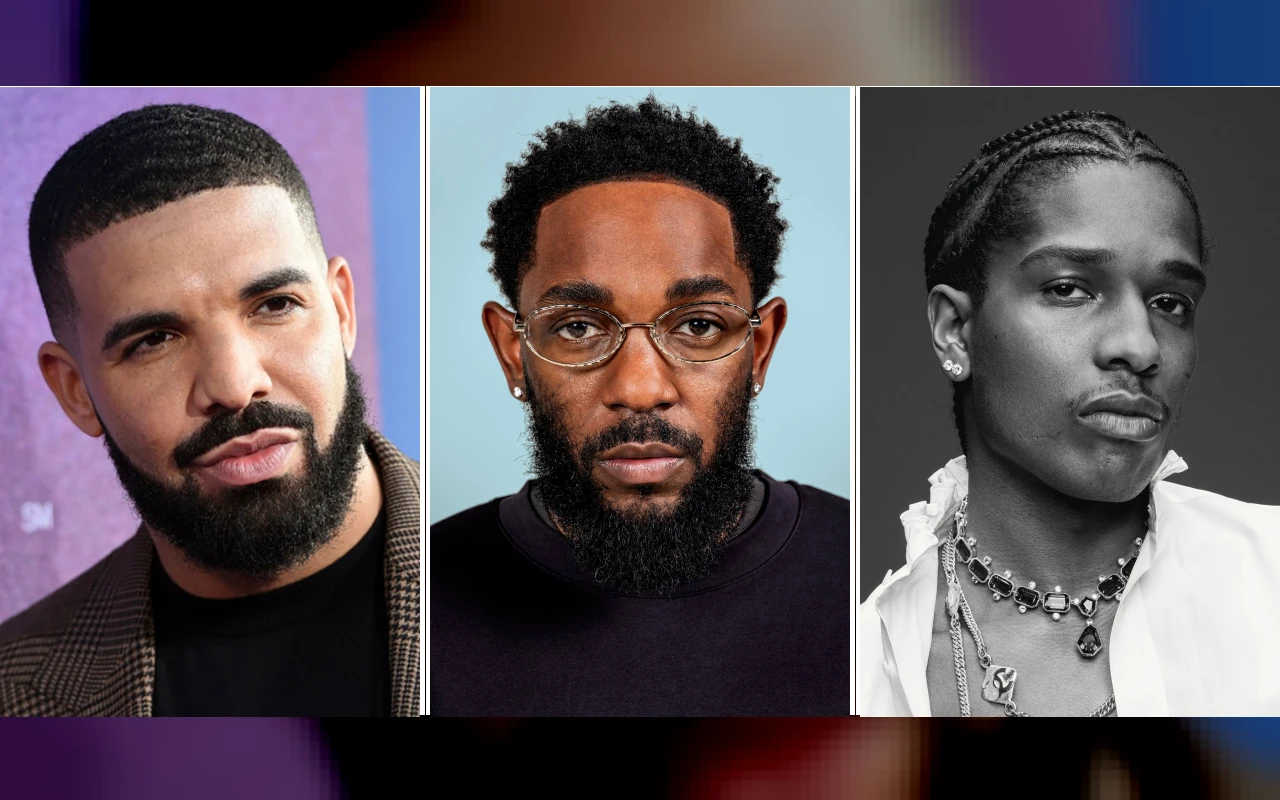
Here's how the Drake-Kendrick saga unfolded: a leaked track, a devastating response, and allegations that redefined rap's biggest feud.
- May 19, 2026
AceShowbiz - By May 2024, the saga surrounding Drake had already cemented itself into rap lore. The story is widely recounted: a close confidant leaked Drake’s track “Family Matters” to Kendrick Lamar before its official release, enabling Kendrick to craft a precise and devastating two-song response with "Meet the Grahams" and "Not Like Us." On the latter, Kendrick transcended a typical rap feud and narrated Drake’s cultural demise, opening with the haunting line, “I see dead people,” effectively declaring Drake’s artistic death before the public could even fully grasp the conflict.
The ongoing battle between Kendrick Lamar and Drake had been fixated on obliteration — aiming to erase Drake’s presence as a cultural icon. For a time, it seemed successful. Serious allegations of pedophilia and grooming became permanently associated with Drake’s public persona, shouted in venues worldwide with fervor. Further complicating matters, Drake’s lawsuit against Universal Music Group over defamatory content in “Not Like Us” was seen as breaking the unspoken codes of rap battles, reinforcing the perception that despite nearly two decades of commercial dominance, Drake remained an outsider to authentic rap culture.
However, two years later, Drake has returned, visibly transformed and ready to confront his past. In the high-budget, cinematic visuals for “Whisper My Name” from his anticipated album Iceman, Drake prowls snowy crime scenes and frozen landscapes, signaling a new chapter. Elsewhere, he challenges A$AP Rocky in “Burning Bridges,” raising a shot glass while taunting, “Where she at?/Where she go?” The video for “Make Them Know” depicts Drake fueling a gas canister to ignite a bot farm, a controversial scene that stirred reactions in Toronto.
Drake’s three-album release on Friday does more than mark a comeback; it undertakes the monumental task of redefining the entire discourse surrounding his career and cultural position. Starting with the battle-scarred and resilient Iceman, and culminating in the expansive, diasporic soundscapes of Habibti and Maid of Honour, the trilogy showcases the versatile, genre-blending style that Drake mastered with projects like 2017’s More Life. At his best, this fluidity challenges the rigid authenticity politics that many of his critics cling to, exposing them as a nostalgic longing for fixed cultural boundaries. Ironically, despite his own controversies, Drake may ultimately prove to be correct in his approach.
Within mainstream conversations, “Not Like Us” became a simplified symbol of what the internet dubbed the Black consensus — reducing a complex, dynamic culture into a clear-cut “us versus them” narrative. This neat division, with its moral certainties, is exactly the kind of story white cultural institutions instinctively reward.
Drake doesn’t need to state this outright to reveal its flaws. Take, for example, “Ran to Atlanta,” which features Future and the rising Southern California rapper Molly Santana, who recently gained independence from Victor Victor. While Kendrick’s critique wasn’t solely about collaborations, “Not Like Us” framed Drake’s involvement with Atlanta as a simplistic morality tale, where the city symbolized an authentic Blackness that Drake could only imitate from the outside. Yet Kendrick’s historical framing doesn’t hold up under scrutiny. His vague folkloric rhetoric, evoking “settlers” and “town folk,” distills genuine anxieties into a symbolic drama casting Drake as an outsider villain. Although “Ran to Atlanta” isn’t among Drake’s most compelling works with Atlanta artists, it chips away at his detractors’ flawed logic. What distinguishes Drake’s role in Atlanta’s music scene from the many others—artists, executives, media, corporations—who have profited from the city’s culture for decades? And notably, very few major Atlanta rappers publicly endorsed Kendrick’s perspective.
On “Make Them Remember,” Drake delivers another sharp rebuttal. The gleeful way “Not Like Us” wielded the pedophilia accusation is unsettling, and Drake confronts this head-on, rapping, “Pedo bars going Number One, and y’all trying to tell me who’s grooming who?” This counters his earlier defense on “The Heart Pt. 6,” where he claimed his fame made the allegations impossible. Regardless of one’s beliefs about Drake, the speed with which the accusation morphed into communal entertainment was striking. The strange part was less belief in the claim and more how quickly it became spectacle. At a time when public attention spans for allegations were fleeting, millions turned the language of child abuse into mass entertainment — a deeply disturbing phenomenon, especially viewed with some distance.
This issue strikes at the heart of what Drake seems most agitated about on Iceman. His bitterness lingers longer than necessary, but this is the first time in a decade where his self-seriousness feels somewhat justified. There is character assassination, and then there is having the world label you a pedophile at the Super Bowl. Whatever “rules” of hip-hop governed diss tracks—interesting how the genre’s sacred creeds don’t extend to breakdancing or graffiti—appear selectively enforced only when Drake is involved. This double standard has been a recurring grievance throughout his career, expressed with varying success.
Iceman dedicates much of its hour-long runtime to dismantling the accusations against Drake, which at times makes the album feel weighed down by rebuttals. Even for those who find pedophile jokes distasteful, the responses sometimes come across as belated and excessive. Moreover, Drake’s ongoing jabs at A$AP Rocky begin to feel tiresome by this point.
Despite these drawbacks, Drake still provides the catchy hooks expected of him. “Janice STFU” introduces a fresh vocal texture, while “Shabang” lands squarely in the joyous territory of his past hits. “2 Hard 4 The Radio” flips the West Coast sound used against him on “Not Like Us” into a club banger, sparking online conversations about the cynicism behind regional gatekeeping. Although Iceman is not Drake’s most groundbreaking work, it achieves the crucial goal of clearing the slate after he was effectively declared “dead” by his critics — an impressive feat in its own right.