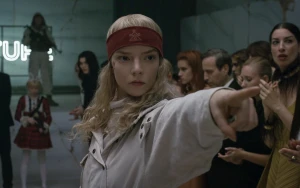
British singer-songwriter Raye’s second album, *This Music May Contain Hope*, is a cinematic 17-track journey through despair, self-criticism, and resilience.
- May 3, 2026
AceShowbiz - British singer-songwriter Raye has released her second album, This Music May Contain Hope, a sprawling and immersive work that challenges listeners to engage fully. Clocking in at nearly the length of a feature film with 17 tracks, the album feels cinematic, with many songs evoking the mood of a soundtrack. Its closing track, “Fin.,” features a six-and-a-half-minute-long thank you to everyone involved in the record’s creation, ending what is described as a gloriously disorienting listening journey.
Throughout most of the album, Raye invites fans to accompany her through emotional battles marked by despair, self-criticism, and a persistent fight to keep hope alive. This struggle is sometimes conveyed through songs reminiscent of show tunes or gospel hymns. For example, “Click Clack Symphony” builds to a crescendo akin to a Hans Zimmer score. The album demands patience and active listening—it is confrontational and confessional and not meant for passive consumption. This Music May Contain Hope is part of a recent wave of ambitious pop records that call for intentional engagement from audiences.
Last year, Hayley Williams took a unique approach with her album Ego Death at a Bachelorette Party, releasing it as 17 individual singles. Fans were encouraged to create their own order and narrative based on the themes and sounds of each track. Similarly, Rosalía’s Lux, released several months later, is an 18-track record sung in 13 languages. Lux shares Raye’s musical complexity and, like The Apple Tree Under the Sea, the debut album from Hemlocke Springs released earlier this year, explores deep emotional and existential themes. These albums all consume the listener with ideas around mental anguish, faith, religion, and personal turmoil.
Raye often describes music as medicinal. On “I Know You’re Hurting,” she is backed by the London Symphony Orchestra and the Flames Collective choir, crafting melodies and harmonies that act as bandages for emotional wounds. She instructs listeners to “close your eyes and let this music get to working,” embodying the wisdom of an elder passing down remedies through generations. At a time when music is often consumed passively, these albums replace fleeting distraction with connection and compassion, giving audiences works they can return to repeatedly.
The opening of “Life Boat” features the voices of Raye’s grandparents. Her grandfather’s line, “I’m living, not giving up,” was recorded just days before his passing. Over the next four minutes, more voices join in, repeating variations of “I’m not giving up, yet,” with varying degrees of desperation. Raye commands, “Say it, say, ‘I’m not giving up, yet,’” setting this mantra against a thudding club beat reminiscent of her early career. The arrangement layers drums and synthesizers with delicate strings, but it is Raye’s transcendent vocal presence that stands out.
This idea of vocal power connects closely with Rosalía, who frequently speaks about “Duende,” a flamenco term describing an enchanting vocal delivery. It is less about technical skill and more about an ethereal quality that feels divine and personal. Rosalía told The New York Times last year that Duende “visits you” unexpectedly, lending her album Lux an intimate and transcendent atmosphere despite its linguistic diversity.
For example, Rosalía begins “Mundo Nuevo” in Spanish, searching for truth, and closes “De Madrugá” in Ukrainian, singing, “I’m not looking for revenge. Revenge is looking for me.” The London Symphony Orchestra and the Escolania de Montserrat i Cor Cambra Palau de la Música Catalana choir enhance the album’s soundscape with arrangements ranging from anxious and erratic to calming and hypnotic, further deepening the listening experience.
Rosalía introduced Lux with the single “Bergain,” a song that intertwines German, Spanish, and English. The track’s outro features Yves Tumor, whose voice delivers the abrasive line, “I’ll fuck you till you love me,” contrasting sharply with the preceding moments. This friction exemplifies the album’s theme of existential questioning and reflections on the afterlife. While it may alienate some listeners, those who stay are rewarded with a rich, multilayered experience.
Much of Lux draws inspiration from saints such as Teresa of Ávila and Joan of Arc, adding a historical and spiritual dimension. Hemlocke Springs also focuses on religious themes in The Apple Tree Under the Sea, blending medieval stories with fantastical adventures. Positioning herself as a character in these tales allows Springs to create a narrative for listeners to follow while maintaining a clear boundary between fiction and reality.
In this way, The Apple Tree Under the Sea shares a theatrical accessibility with Raye’s This Music May Contain Hope. Raye’s cautionary stories about untrustworthy South London men who should be banned from WhatsApp play into the same theatrical space as Springs’ tracks “Head, Shoulders, Knees and Ankles” and “Moses.” Towards the end of Springs’ album, a distant male voice preaches about sin and final judgment amidst the sounds of running horses and marching feet. The tension builds into an orchestral outro leading into “Sense (Is),” an optimistic, anthemic track about embracing fresh starts and hope.
Hemlocke Springs’ album spans 10 songs just over 30 minutes but maintains complexity through narrative twists. Each artist in this group communicates differently: Springs through stories and allegories, Raye through a theatrical lens, and Rosalía through multinational, cathedral-like soundscapes. Meanwhile, Hayley Williams’ Ego Death at a Bachelorette Party grounds listeners in a vivid, raw reality.
Williams’ haunting “True Believer” takes listeners through Nashville’s streets, down Broadway, past repurposed clubs, and into churches where the rhetoric is questioned. The album captures moments of fragility within a metaphorical home of glass walls, making the experience intensely personal.
The album’s most poignant moment arrives near the end with “Good ‘Ol Days.” Unlike the distress of “Negative Self Talk” or the sober tones of “Whim,” this track flows with a warm groove and features sharp, burning one-liners. Its strength lies in its capacity to balance vulnerability with humor and pointed specificity, emphasizing the emotional depth that characterizes the entire album.
These recent ambitious albums—from Raye to Williams, Rosalía, and Hemlocke Springs—signal a shift in pop music toward works that demand more from their audiences. They ask listeners to engage actively, to reflect deeply, and to find connection and meaning beyond surface-level enjoyment. As music consumption increasingly trends toward passive streaming, these records stand out by offering rich, layered experiences that reward patience and attention, promising listeners an emotional journey that lingers long after the final note.