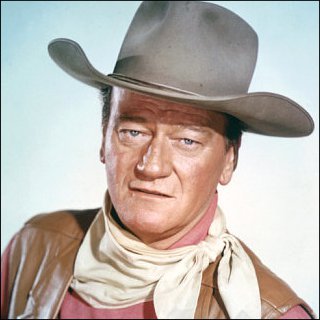
John Wayne
- Attended Glendale Union High School, Glendale, California
- Attended University of Southern California
Marion Michael Morrison, known professionally as John Wayne, was an iconic American actor whose career spanned several decades and left an indelible mark on the entertainment industry. Born on May 26, 1907, in Winterset, Iowa, Wayne became a symbol of American masculinity and patriotism through his memorable performances in Western and war films, particularly during Hollywood's Golden Age. He garnered fame not only for his rugged persona but also for his ability to embody the spirit of the American frontier, making him one of the most celebrated stars in cinema history.
Wayne's early life was marked by a move to Southern California, where he grew up. Initially, he pursued a football scholarship at the University of Southern California, but a bodysurfing accident derailed his athletic ambitions. This turned his focus toward the film industry, leading him to work for the Fox Film Corporation in the late 1920s. He started with minor roles, but his breakthrough came with the 1930 release of Raoul Walsh's epic Western, The Big Trail. Despite its initial box-office failure, this film showcased Wayne's potential as a leading man. Throughout the 1930s, he starred in numerous B movies, predominantly Westerns, gradually building a reputation without achieving major fame.
The turning point in Wayne's career arrived in 1939 with his role in Stagecoach, directed by John Ford. This film catapulted him into the spotlight, establishing him as a mainstream star. From that point forward, Wayne became a fixture in American cinema, starring in a remarkable total of 142 motion pictures. His performances in classics such as Red River (1948), where he portrayed a cattleman driving his herd along the Chisholm Trail, and The Searchers (1956), in which he played a Civil War veteran on a quest to rescue his niece from a tribe of Comanches, solidified his status as a leading actor. Additionally, his portrayal of the one-eyed marshal in True Grit (1969) earned him an Academy Award for Best Actor, further cementing his legacy.
Throughout his career, Wayne collaborated with many notable filmmakers and actors, including Maureen O'Hara in The Quiet Man (1952), Dean Martin in Rio Bravo (1959), and James Stewart in The Man Who Shot Liberty Valance (1962). His final performance came in The Shootist (1976), where he portrayed an aging gunfighter battling cancer. Wayne's last public appearance was at the Academy Awards on April 9, 1979, where he received a standing ovation, a testament to his enduring impact on cinema.
John Wayne passed away on June 11, 1979, from stomach cancer, but his legacy lives on. In 1980, he was posthumously awarded the Presidential Medal of Freedom, the highest civilian honor in the United States, recognizing his contributions not just to film, but to American culture. In 1999, the American Film Institute honored Wayne as one of the greatest male stars of classic American cinema, underscoring his significance in the history of film. His distinctive voice, commanding presence, and unwavering embodiment of the American spirit continue to inspire generations of filmmakers and audiences alike.