Turn your kitchen into a lab with fun, easy science experiments for kids. Simple supplies, real learning, and mess-level ratings for every activity.
- October 28, 2026
AceShowbiz - You know that moment when your kid asks "why is the sky blue?" and you realize you're about to wing it? Here's a secret: you don't need a science degree to raise a curious kid. You need a box of baking soda, some food coloring, and about twenty minutes on a rainy Saturday.
Science experiments at home do more than kill boredom. Research from the University of Chicago found that when parents talk with kids about how things work — asking questions together, testing ideas together — kids show measurably stronger science reasoning by kindergarten. The experiments below use stuff you already own, take under 30 minutes, and are rated for mess so you can pick the right one for your energy level.
Why Kitchen Science Beats Screen Time (and What the Research Says)
Hands-on experiments aren't just cute. A landmark study in the journal Science found that kids who physically act out science concepts retain them far better than kids who just read or watch. When your child pours vinegar into baking soda and feels the cup get cold, that's a real chemical reaction teaching a real lesson — and their brain is wired to remember it.
The other win is the questions. A good experiment creates a "wait, what happened?" moment, and that moment is where curiosity lives. Kids who get regular chances to be surprised by how the world works are more likely to keep asking questions in school, not less.
One practical tip before you start: resist the urge to explain everything right away. When the balloon inflates, ask "what do you think made that happen?" first. Let them guess wrong. Wrong guesses followed by testing are literally how scientists work.
Five Experiments You Can Run With Stuff Already in Your Kitchen
1. The Baking Soda Volcano (Mess level: medium)
You know this one, but most people skip the best part. Fill a small cup halfway with baking soda, put it in a shallow dish, and pour in vinegar mixed with a squirt of dish soap and a drop of red food coloring. The soap makes the foam last longer, which gets a bigger reaction.
The real lesson: ask your kid to try it again with baking powder, or with cold vinegar, and see if anything changes. Now they're not just watching a volcano — they're running a controlled experiment.
2. The Walking Water Rainbow (Mess level: low)
Line up six clear glasses. Fill glasses 1, 3, and 5 with water tinted red, yellow, and blue. Leave 2, 4, and 6 empty. Fold paper towels into strips and bridge each glass to the next. Wait about two hours.
Water climbs the paper towels and mixes in the empty glasses, creating new colors. It's capillary action and color mixing in one slow, satisfying show. Great for ages 4–8, and you can set it up before lunch and check it after nap.
3. The Egg in a Bottle (Mess level: low, adult supervision needed)
Peel a hard-boiled egg and set it on the mouth of a glass bottle with an opening slightly smaller than the egg. Have an adult drop a lit match into the bottle and quickly set the egg back on top. The egg gets sucked in.
Why? The flame heats the air, which expands and pushes some air out. As it cools, the pressure drops inside and the higher outside pressure shoves the egg in. This one is genuinely impressive to kids and takes two minutes.
4. Density Tower in a Jar (Mess level: medium)
Pour honey, then corn syrup, then dish soap, then water, then vegetable oil into a tall clear jar — slowly, down the side. Each layer floats on the one below because of density. Drop in a grape, a piece of pasta, and a coin and watch them settle at different levels.
This is the experiment kids ask to repeat most, because the results look like a magic trick. It also doubles as a lesson in why oil spills float on water.
5. Static Electricity Balloon Race (Mess level: none)
Blow up two balloons, rub each on a wool sweater for ten seconds, and stick them to a wall. They'll stay. Then rub one balloon and hold it near a thin stream of water from the tap — the water bends toward it.
This one is perfect for the "I don't want to clean up anything" days. It takes five minutes and teaches kids that invisible forces are real.
How to Set Up a Mess-Free (or Low-Mess) Experiment Station
You don't need a dedicated room. A rimmed baking sheet on the kitchen table catches 90% of spills, and a roll of paper towels within arm's reach handles the rest. Keep a small bin with the basics — baking soda, vinegar, food coloring, cornstarch, clear cups — so setup takes seconds instead of a scavenger hunt.
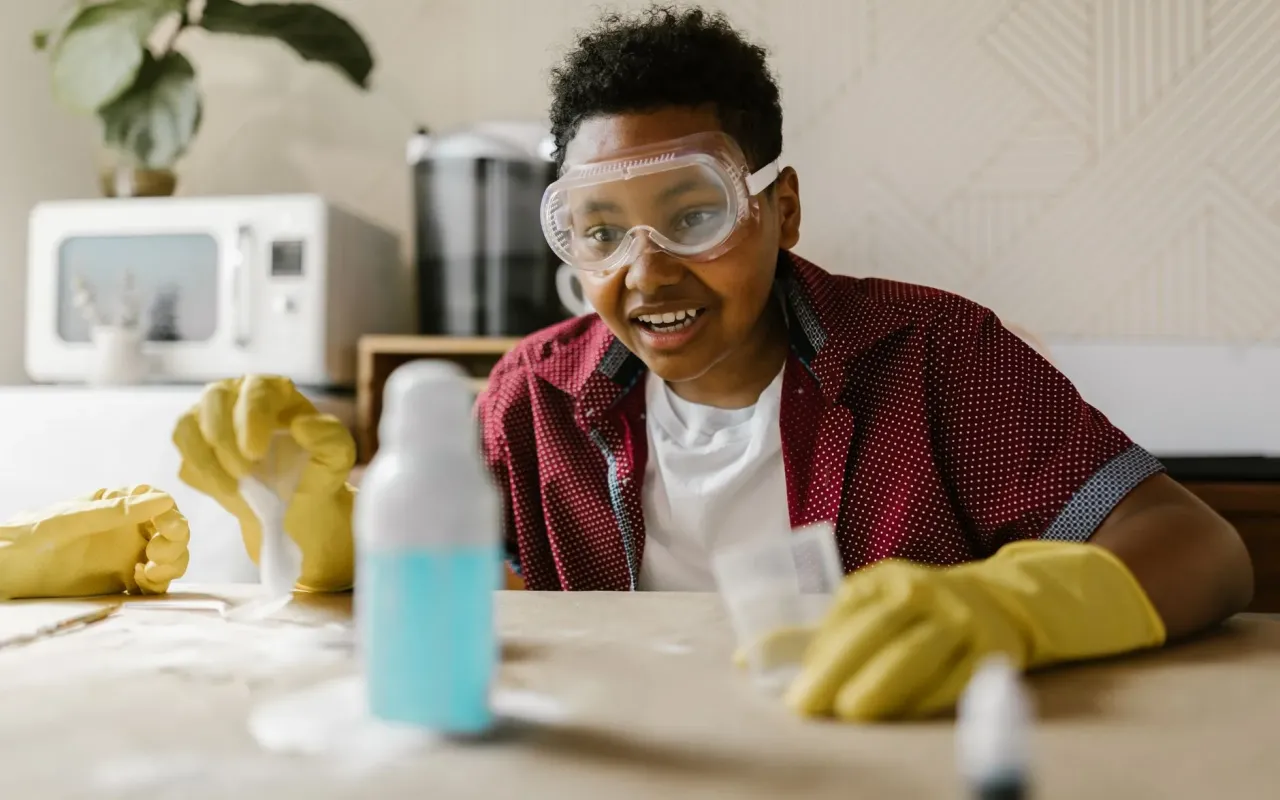
For kids who hate getting their hands dirty, offer tools: pipettes, spoons, tongs. Some kids engage more when they're the "director" rather than the hands. And for kids who love mess, give them an old shirt as a lab coat. The costume matters more than you'd think for buy-in.
One safety rule that covers almost everything: no tasting experiments, and adults handle anything involving heat, flames, or glass near a hot surface. Everything else on this list is safe for supervised kids ages 4 and up.
Turning a Five-Minute Experiment Into an Hour of Learning
The experiment itself is the hook. The learning happens in the follow-up questions. After the density tower, ask: "What would happen if we used warm water instead?" After the balloon, ask: "Why do you think it stuck to the wall and not the window?"
Keep a simple "lab notebook" — a spiral notebook where your kid draws what happened and dictates one sentence about it. This is exactly what real scientists do, and it builds writing skills without feeling like homework. Kids as young as five can draw the setup and label it with a single word.
Try one "what if" variation per experiment. Change one variable, predict what will happen, then test it. That single habit — predict, test, compare — is the entire scientific method in kid-sized form, and it's the thing that transfers to school science classes later.
What to Do When the Experiment Flops (Because Sometimes It Will)
Your egg won't get sucked in. The colors won't mix. The balloon won't stick. It happens, and it's actually the most valuable part of the whole experience — because real science is mostly failed attempts followed by adjustments.
When something doesn't work, say out loud: "Huh, that didn't go how I expected. What should we change?" That sentence models exactly the attitude you want your kid to have toward problems in general — not just in science. Kids who learn that failure is information, not a verdict, handle school and life very differently.
If an experiment flops twice, swap it out and come back another day. The goal isn't a perfect result. It's a kid who walks away thinking "I wonder what would happen if..." — and that thought is worth more than any worksheet.