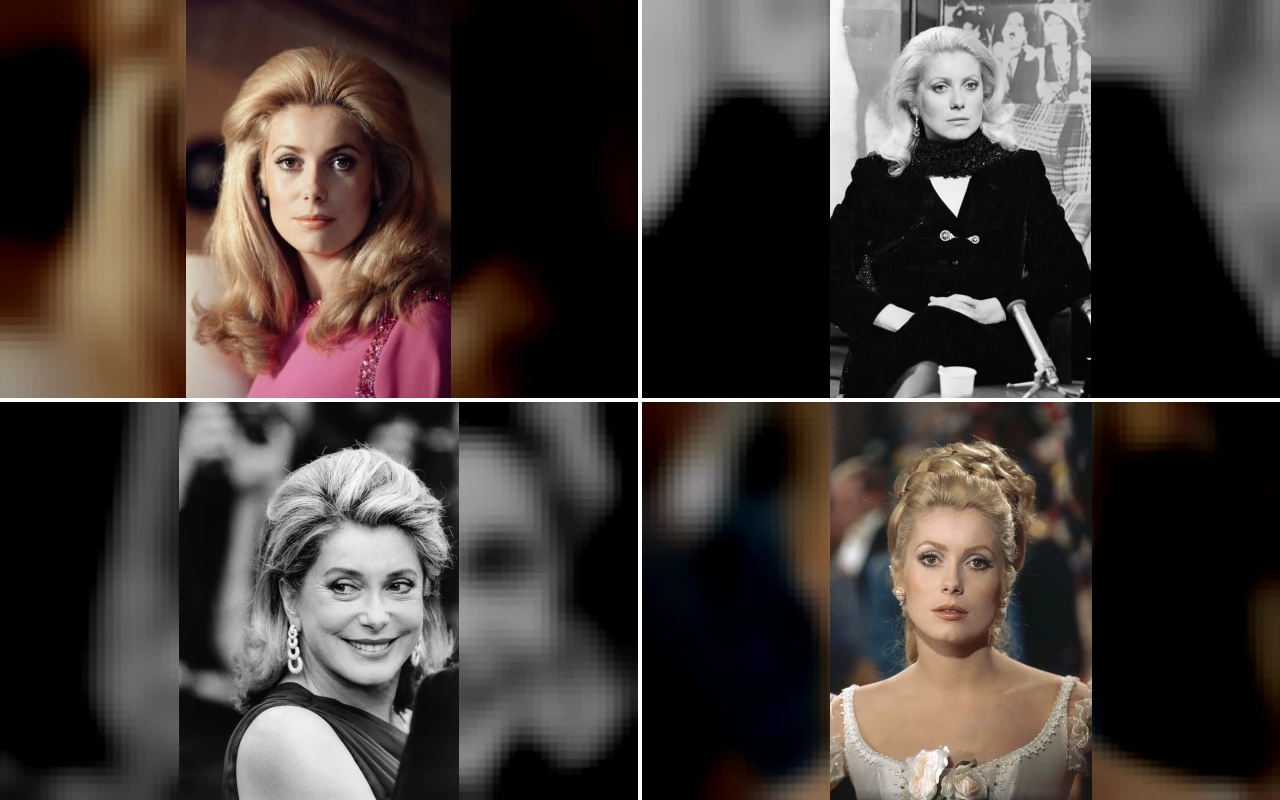
Catherine Deneuve at Cannes 2025 with her Shiba Inu Jack, vaping, and reflecting on French cinema, Marianne, and her timeless elegance.
- May 12, 2026
AceShowbiz - Catherine Deneuve arrived at the 77th Cannes Film Festival accompanied, as always, by her faithful Shiba Inu named Jack. “Not Jacques, Jack!” she clarifies, as the alert, pointy-eared dog remains quietly attentive throughout their conversation, almost like a discreet guardian.
The interview takes place in an intimate corner of a boutique hotel on Paris’s Left Bank. Deneuve’s elegant Louis Vuitton handbag lies casually on a chaise lounge nearby. During the discussion, she intermittently inhales from her vape, admitting, “I did quit smoking for a while, even tried hypnosis, but I started again. This, however, is not smoking. It’s nothing.”
This setting is both relaxed and sophisticated, much like the actress herself. Catherine Deneuve represents more than just French cinema; she embodies France's cultural essence. In 1989, her face was chosen as the image of Marianne, the French Republic’s emblem of liberty and reason, an honor that cements her iconic status.
Deneuve’s filmography spans a remarkable range of characters, illustrating her versatility and depth. She was Geneviève, the innocent romantic lead in Jacques Demy’s 1964 musical The Umbrellas of Cherbourg, a role that launched her international stardom after the film won the Palme d’Or. Contrasting that, she portrayed the psychologically disturbed Carole Ledoux in Roman Polanski’s 1965 thriller Repulsion, revealing a darker and more complex side.
Her career further expanded with Luis Buñuel’s Belle de Jour (1967), where she played Séverine, a high-society housewife with secret desires, blurring lines between repression and liberation. In later years, she embraced camp and self-parody in films like Tony Scott’s lesbian vampire thriller The Hunger (1983) and François Ozon’s musical mystery 8 Women (2002).
Deneuve’s persona has always reflected a fascinating duality: at once radical and conservative, liberated yet restrained. This contradiction has become a hallmark of both her career and the French cinema she epitomizes. More than a festival fixture, she is a living legend of Cannes, returning not merely as a symbol of past glory but as a committed and active artist.
This year, Deneuve appears in two films competing at Cannes. The first is Parallel Tales, an ensemble drama directed by two-time Oscar winner Asghar Farhadi, featuring stars like Isabelle Huppert and Vincent Cassel. The second is Gentle Monster by Austrian filmmaker Marie Kreutzer, in which she plays the mother of Léa Seydoux’s character.
Despite her stature, she describes these roles as “very small,” emphasizing the importance of each character’s purpose. “If the character were removed, would the story still matter? If not, then it isn’t interesting,” she explains. She is also drawn to young directors whose enthusiasm and fresh perspectives invigorate her desire to participate.
Cannes has been a constant thread throughout Deneuve’s career. Her breakthrough came with The Umbrellas of Cherbourg, a fully sung musical that required the cast to memorize the entire score before filming. “We knew the film was special while shooting it,” she recalls. Winning the Palme d’Or at just 20 years old was surreal, a moment she describes as not fully comprehended at the time.
She also fondly remembers the 2000 Palme d’Or awarded to Lars von Trier’s Dancer in the Dark, starring Björk, a moment of recognition she regards as deeply significant.
Over decades, Deneuve has returned to the Croisette so many times that she has lost count. Among them, the 1994 festival stands out when she served on the jury alongside Clint Eastwood. That year, the jury awarded the Palme d’Or to Quentin Tarantino’s Pulp Fiction, a decision that sparked controversy and marked a turning point for independent cinema.
“The theater erupted with anger,” she recalls. “People didn’t understand the film’s new style.” Within the jury, however, the decision was unanimous, though Eastwood remained notably reserved about discussing it.
Scandal and controversy have long followed Deneuve, who has portrayed complex, transgressive characters over her six-decade career—from serial killers to submissive housewives and vampires. The innocent Geneviève of The Umbrellas of Cherbourg would likely be shocked by the boldness of some of these roles.
Just a year after her debut, she underwent a dramatic transformation for Repulsion, shifting from openness to chilling emotional detachment. Her portrayal in Belle de Jour solidified her reputation as French cinema’s “ice queen,” embodying a figure poised between repression and release, an enigmatic object of desire.
Despite these complexities, Catherine Deneuve endures as a towering figure in cinema, a woman whose career and persona embody the elegant contradictions of French culture itself. At Cannes 2024, she continues to captivate not as a relic of the past but as a passionate artist embracing new challenges.
Her presence reminds audiences why she remains not only the queen of the Croisette but also one of the most compelling and enduring icons of international film.